
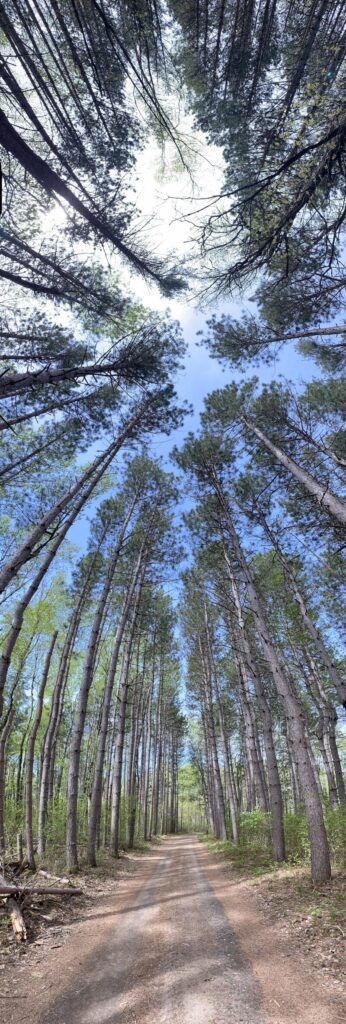
Minnesota and other Upper Midwest states are blessed with an environment that grows amazing hardwood and softwood trees. In my infinitesimally small participation in crafting a culture, I believe it is meaningful to make objects directly tied to the environment in which they grew. A tradition that goes back to the first items people crafted with tools, taking what was available and adjusting the design based on the characteristics of the materials at hand. For me, this is what it means to work authentically. I don’t try to mimic a style by importing wood, tools and designs from another culture (not to say we can’t be inspired), the work is directly connected to our place, needs and materials. Building a Minnesota furnishing style based in the trees and history of this place (sometimes as close as my own neighborhood) is half the reason I stick to the lumber harvested near me.
The other half is environmental. I believe we are called upon to care for the Earth, to find a sustainable way of life for humans and all life on this planet; I can not see any way shipping a log half way around the globe is sustainable.
Beyond the GHG emissions, there is also a question about forestry practices. After the clear cutting of the old growth forests, it became pretty obvious to the forestry industry they needed to plant more than they cut. They are the industry that has spent the most time contemplating and working towards a sustainable system; the most recent report from the National Forest service says, “At the national scale, forests continue to grow significantly more wood than is removed or lost to mortality”. This gives me some confidence in using lumber from the US, while not ignoring many ongoing issues with US forestry management.
I am sure most countries have similar or even better forestry practices than the US, but I have almost no insight on other countries’ timber industries. A lot can be hidden in a global supply chain where logs change hands multiple times. Did the logs come from certified good forest designation or were they smuggled into the supply chain and actually came from unsustainable forestry practices? We really have no way to know. I travel around Minnesota and read Minnesota-based news sources, if the forests of the Upper Midwest were poorly managed, I would hear about it, and have a better chance of responding.
For all those reasons and a few more, I choose to use domestic lumber in all of my woodworking and carpentry.
According to the Minnesota Department of Natural Resources, these are the native tree species both hardwood (Deciduous) and softwood (Coniferous). Many of these species are not sold commercially, or they are grouped under broad categories like “Maple” or “Cedar”. Despite the lack of availability in the market place, I have worked with many of these woods.
Deciduous
- American mountain ash
- Ash
- American basswood
- Birch
- Black walnut
- Box elder
- Butternut
- Blue beech
- Cherry
- Elm
- Hackberry
- Hickory
- Honeylocust
- Ironwood
- Kentucky coffeetree
- Maple
- Red mulberry
- Showy mountain-ash (Northern mountain-ash)
- Oak
- Poplar
- Willow